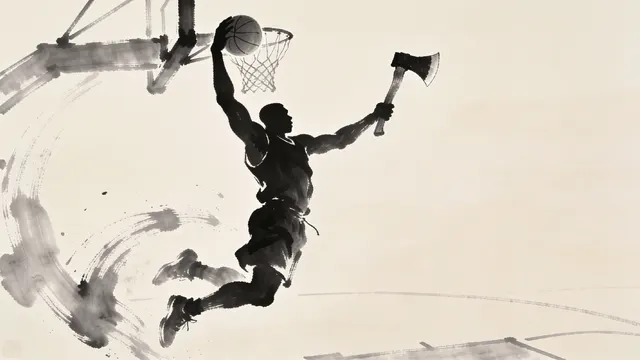
Michael Jordan 1997: The Coronation Moment and Its Era Significance
In the 1997 NBA Finals, the Chicago Bulls defeated the Utah Jazz four games to two, and Michael Jordan once again lifted the Larry O'Brien Trophy, unanimously earning the Finals MVP. This title meant far more than a trophy: it certified the dominance of Jordan and this team, and rewrote the league's power map. A year after the 72-win romp, the Bulls met a tougher, more disciplined opponent, and the series became a grind that tested every ounce of their championship mettle.
In the series Jordan delivered a convincing performance, averaging 32.0 points, 7.0 rebounds and 6.0 assists and scoring 38 in the pivotal Game 5 while visibly ill, defining the series' direction with real domination. The image of him leaning on Scottie Pippen walking off the floor in Salt Lake City became the enduring symbol of that title, a picture of greatness purchased at physical cost most players would not attempt. The league awarding the FMVP to Jordan was no accident; it was the fair recognition of a player who carried his team past the highest threshold, because the FMVP is decided solely by who was most decisive in the games that decided the championship, not by cumulative regular-season numbers.
From that year, Jordan's name was carved deeper into basketball's foundation as a coordinate later generations look up to. A fifth title and a fifth Finals MVP placed him beyond any simple comparison, the undisputed head of a second three-peat in progress. The 1997 crown proved that greatness is not only about ease but about will, the capacity to produce when the body says no. Coaches still point to that Finals as the clearest example of a competitor refusing to surrender. The trophy is no longer a debate; it is a statement that the era's defining player would not be denied.
What made the moment historic was the opponent. Utah had won 64 games behind Karl Malone and John Stockton, the most disciplined offense in the league, and the Jazz pushed Chicago to six hard games. This was no 72-win walkover; the Bulls had to grind, and Jordan had to will them through the two games in Salt Lake City where the altitude and his own illness conspired against him. That context is why the fifth title carries a different weight than the fourth: it was earned in discomfort, not in command.
The second three-peat was now one win from completion, and the basketball world understood it was watching something that might never be repeated. A player who had retired at the top, played baseball, and returned to win three more titles in a row was rewriting what a career could contain. By the end of Game 6 the question was no longer whether Jordan belonged among the greats, but where exactly he would rank among them. The coronation was complete, and the era had its defining player refusing to let go of the summit. The flu game became the exclamation point, a story told for decades as the purest proof of competitive will.
Related Reading
Related
1997 NBA Finals MVP: Michael Jordan (Chicago Bulls)
Michael Jordan 1997: Spiritual Role Model and the Relentless Foundation

Michael Jordan 1997: Technical Portrait and the Fixation of a Unique Style