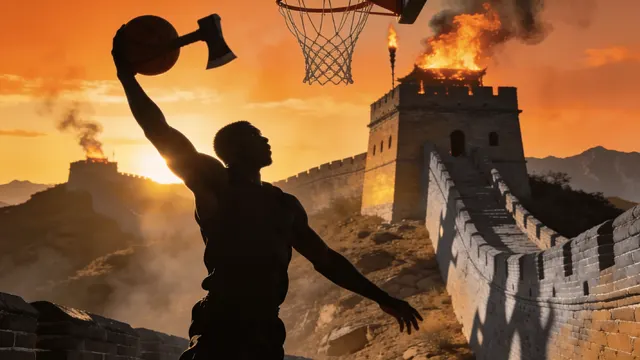
We The North: A Deep Dive Into the 2019 Championship
English feature · same subject as above · Team: Toronto Raptors / Star: Kawhi Leonard
I The Night
June 13, 2019, Oracle Arena, Oakland. The horn sounded and the board read 114-110. The Toronto Raptors had won the first championship in franchise history, and they'd taken the Larry O'Brien Trophy out of the United States for the first time anyone ever had.
The game was its own drama. Eighteen lead changes, nine ties, and neither side up by more than nine at any point. With 2:22 left in the third, Klay Thompson drove and got fouled by Danny Green and went down holding his left knee. He was helped off, got as far as the tunnel, turned around, walked back out, shot his two free throws, and left the building on crutches. He had 30 points by then. It was an ACL.
The ending was stranger. Curry missed a contested three, Golden State called a timeout they didn't have, and Kawhi Leonard went to the line for the technical. He made one. Three-point game, 0.9 seconds left. That was it.
Kyle Lowry scored the first eight points of the game and finished with 26, 10 rebounds and 7 assists. Pascal Siakam had 26 and 10. Fred VanVleet came off the bench for 22 with five threes. Leonard finished with 22, 6 and 3, and when it ended the most expressionless man in basketball threw his head back and got swallowed by his teammates.
It was also the last game Oracle Arena ever hosted. Forty-seven years of Warriors basketball in that building, from Rick Barry to Curry, and the last buzzer went with the road team holding the trophy. Golden State's crowd chanted "Warriors" on the way out. Serge Ibaka stuck his head through the rim.
Toronto had waited 26 years for a professional championship of any kind, going back to the Blue Jays in the 1993 World Series. Canada finally had an NBA title of its own.
Leonard stood on the podium in a hat and a pair of ski goggles someone had handed him, getting soaked in champagne, and said the thing everyone remembers: he'd wanted to make history there, and that's what he did.
VanVleet's fourth quarter deserves its own paragraph. He'd been in and out of the rotation for two months, dealing with a hand injury and shooting like a man who couldn't find his stroke, and then in the last six minutes of a Finals clincher he made three straight threes. Every time Golden State cut it to one possession, he pushed it back to two. Undrafted, nearly out of the league a year earlier, and the reason Toronto never had to play a Game 7.
II The Finals MVP
The 2019 Finals MVP was Kawhi Leonard. It was the second of his career; the first came with San Antonio in 2014.
That put him on a very short list: the third player ever to win Finals MVP with two different franchises, after Kareem Abdul-Jabbar and LeBron James. There's a footnote that makes his case stranger — he's the first to do it with a team from each conference, one in the West and one in the East.
He's also just the fourth player to win the award in his first season with a new team, joining Magic Johnson in 1980, Moses Malone in 1983 and Kevin Durant in 2017. One year, one title, one trophy. It doesn't happen often.
Across the six games he averaged 28.5 points, 9.8 rebounds, 4.2 assists, 2.0 steals and 1.2 blocks, getting to the line 11.7 times a night. The whole postseason is where it gets silly: 24 games, 30.5 points, 9.1 rebounds, 3.9 assists and 1.7 steals, shooting 49% from the floor and 38% from three with a 61.9% true shooting mark.
He scored 732 points in that playoff run, third-most in a single postseason in league history behind Michael Jordan's 759 in 1992 and LeBron's 748 in 2018. Fourteen of his 24 games were 30-point nights.
He'd played 60 regular-season games. "Load management" entered the league's vocabulary that year because of him, and the Raptors were mocked for it from October to April. Then the playoffs started and everybody shut up about it.
His regular season, for the record, was the best of his career — 26.6 points and 7.3 rebounds a game, with a career-high 45 against Utah on New Year's Day and a run of 22 straight games with 20 or more. All of it was preamble.
The defensive half is what people leave out. He took the Giannis assignment in the conference finals and made the league's MVP work for everything he got, then spent the Finals switching onto whoever Toronto needed stopped. He made All-Defensive Second Team that season, which for him counted as a down year. In a sport that hands its biggest individual awards to scorers, he won one by being the best player at both ends of the floor that spring.
The gap between his two Finals MVPs is worth sitting with. In 2014 he was 22, a role player on a San Antonio machine, averaging 17.8 points and mostly knocking down open looks while Duncan and Parker carried the load. Five years later he was the entire offense for long stretches, the primary defender on the other team's best player, and the last option with the game on the line. Same trophy, completely different player holding it.
III The Shot and the Comebacks
The real turning point of this title came in Game 7 of the conference semifinals. Toronto and Philadelphia, final seconds, tied at 90. Leonard catches it in the right corner with a seven-footer in his face and lets it go. It hits the rim. Bounces once, twice, three times, four. Then it falls. 92-90.
It was the first buzzer-beater to end a Game 7 in NBA history. The building froze for a beat and then absolutely lost its mind. Leonard went to his knees at the baseline with his hands on his head and got buried by his teammates — a man famous for having no pulse, screaming at the top of his lungs. He'd taken 39 shots and scored 41.
In Game 1 of that same series he'd gone for a playoff career-high 45 on 16-of-23. If the shot doesn't fall, this whole season is a completely different story and probably a cautionary one.
Then came Milwaukee. Toronto lost the first two to the team with the best record in basketball, with a guy about to win MVP, and then won four straight. They became the sixth team ever to come back from 0-2 in a conference final.
Leonard went for 36 in Game 3 with eight of those in the second overtime, a 118-112 win. In Game 5 he had 35 with five threes, seven boards and nine assists in a 105-99 win. In Game 6 it was 27 and 17 rebounds to close it out, 100-94, plus the image everybody remembers: Lowry steals it, Leonard runs, and dunks on Giannis.
A Game 7 buzzer-beater and an 0-2 comeback in the same postseason. Either one of those is a career. Both happened before June.
Nick Nurse, who'd been an assistant eight months earlier, spent that whole Milwaukee series inventing defenses on the fly. He'd box-and-one a reigning MVP if the math said so, and nobody in the league had the nerve to do that anymore.
The shot itself has been replayed more than almost any in league history and it still doesn't look like it goes in. He'd missed a free throw seconds earlier that would have made it a two-possession game. Then he got it on the right wing, dribbled into the corner, rose over a seven-footer, and the ball bounced four times before deciding what to do. When it fell, the building shook hard enough that the broadcast audio clipped. He said afterward it was the first Game 7 winner of his life, at any level.
IV The Road
The regular season was 58-24, second in the East and second-best in the league, one win shy of the franchise record they'd set the year before. They did it with a top-five defense and a first-year head coach.
Nick Nurse got promoted from assistant in June of 2018 after the team fired Dwane Casey. He didn't tear anything down. He made the defense more specific, and by the Finals he was throwing a box-and-one at Stephen Curry — a scheme that had basically disappeared from the professional game — because it was the right call against that particular opponent.
Orlando went down in five, though Toronto lost Game 1 and the old script looked like it was loading again. Then it stopped loading.
Philadelphia took seven and a bounce. Milwaukee took six after Toronto dropped the first two. Add Golden State and you get the hardest road any champion had that year: the best regular-season record in basketball, a Philadelphia team with Embiid and Butler, and then the two-time defending champions.
They finished 16-8 in the playoffs, which doesn't sound overwhelming. But no round was comfortable, and for a franchise that had spent years getting knocked out early, the point was that they finally had an answer every single time.
The fifth-best defense in the league during the regular season got better when it mattered. Toronto didn't have the best player in every series — they had the best plan in every series, which turned out to be worth more.
By the time they got to Oakland they'd already played 18 playoff games against three of the best teams in basketball. Whatever Golden State threw at them, they'd seen it.
The defensive numbers back up the eye test. Toronto finished fifth in the league in defensive rating that regular season and then got better when it counted, because Nurse could run out Leonard, Siakam, Green and Gasol together and switch nearly everything. Every team they faced had built its offense around finding a mismatch and going at it. Toronto spent three rounds refusing to hand one over, and by June that had stopped being an adjustment and started being who they were.
V The Roster Puzzle
Kyle Lowry was the soul of the team and the most misjudged player in it. He'd spent years getting killed for his playoff performances, and then he had the best series of his life: 26 points, 10 rebounds and 7 assists in the clincher, the game's first eight points, and 14 threes across the six games. Leonard went and found him first when it ended.
Pascal Siakam won Most Improved Player that season, having jumped from 11.9 points a game to 16.9. He opened the Finals with 32 and everyone sat up, then went for 26 and 10 in Game 6. A Cameroonian kid taken late in the first round in 2016 became the second scorer on a champion.
Fred VanVleet went undrafted. He came off the bench in Game 6 for 22 points and five threes and was the reason the fourth quarter didn't turn. His whole career is the thesis of this roster: the guy nobody wanted plays the biggest minutes.
At center it was Marc Gasol and Serge Ibaka. Gasol came over at the deadline from Memphis for Jonas Valančiūnas, Delon Wright and C.J. Miles — three rotation players for one aging center, a move that made no sense unless you were aiming directly at Golden State. Ibaka scored 15 in the clincher.
Danny Green arrived in the trade as the guy everybody forgot about, and spent the Finals hitting shots that hurt. Add Norman Powell, Jeremy Lin and an OG Anunoby who was out injured, and you get a roster whose depth wasn't about talent so much as about everyone knowing exactly where to stand.
None of them were afraid of the moment, which is not something you can coach. Nurse kept saying it all year: it was a tough-minded group. He wasn't doing a press conference bit.
Gasol's arrival changed how the whole offense worked. Valančiūnas was a better scorer and a better rebounder on paper, but he couldn't pass or stretch a floor, and Golden State would have hunted him on every single possession. Gasol came in at 34, slower than he had ever been, and immediately became the man making the right pass out of every double-team. It was a downgrade in raw talent and an upgrade in everything that actually mattered in June.
Nurse's own path explains a lot about why this roster worked. He'd coached in the development league and in Europe for years before anybody in Toronto gave him an NBA bench job, and he won a title with Rio Grande Valley back in 2011. Winning in June made him the first head coach to take both an NBA championship and a development league one. He never once acted like he was above the strange idea.
VI The One-Year Gamble
The bet was placed on July 18, 2018. Toronto sent DeMar DeRozan — nine years with the franchise, a man who never wanted to leave — plus Jakob Poeltl and a protected 2019 first-round pick to San Antonio for Kawhi Leonard and Danny Green.
It got shredded at the time. Leonard had played nine games the previous season because of a quadriceps injury. He had one year left on his deal. Every report said he wanted Los Angeles. Trading a franchise player for a possibly-one-year rental of an injured star looked like self-sabotage to most of the league.
Masai Ujiri's line was that they hadn't made the trade for one year, they'd made it for the future. Everybody understood what it actually was: a bet with the franchise's reputation and a city's feelings on the table.
Load management was part of the same wager. They held Leonard out of back-to-backs and played him 60 games, and took abuse for it all season. Nurse and the medical staff had made their call early: the goal wasn't April, it was June.
The Gasol trade at the deadline was the second layer — three rotation players for a 34-year-old center, a move that only makes sense if you're aiming at one specific opponent. Every decision that season shared the same premise. If they didn't win it that year, none of it mattered.
They won it, and then Leonard signed with the Clippers seven weeks later. Toronto had him for one season — 84 games including the playoffs — and that one season bought the city its first championship.
Ujiri's own reaction afterward was the most honest thing anyone said that night. Standing there with the trophy, he just said he didn't believe it yet.
What made it hard was who they gave up. DeRozan wasn't only the best player in the franchise's history; he was the one who'd chosen to stay, who re-signed when nobody expected him to, who talked openly about mental health and about loving a city most NBA players treated as exile. Trading him for a man who wanted to leave felt like a betrayal to a large part of that fanbase. Winning is the only thing that has ever made it bearable.
VII The Tuition
Golden State played this one broken. They'd reached a fifth straight Finals, and they'd gotten through the first two rounds without Kevin Durant, who strained a calf in Game 5 of the Houston series and hadn't played since.
He came back for Game 5. He played a little over ten minutes, scored 11 points, and then went down with no contact at all on a routine push — a ruptured right Achilles. He had surgery the day before Game 6.
Then Klay. A hamstring in Game 2 cost him Game 3. In Game 6, midway through the third quarter, he landed wrong on a drive and tore the ACL in his left knee. He walked off, got to the tunnel, turned around, came back and shot his free throws. Thirty points, gone.
Curry finished with 21 on 6-of-17, 3-of-11 from deep, and missed the three that mattered at the end. Draymond Green put up a triple-double — 11 points, 19 rebounds, 13 assists — along with eight turnovers. Andre Iguodala had 22, his best game of that postseason.
Steve Kerr handled it better than most would have. More than the what-ifs, he said, he just felt bad for the players. A dynasty's final home game ended with two of its pillars on the floor.
One thing worth saying out loud: Toronto didn't win because Golden State got hurt. They defended better for six games, they won the physical battles, and they were calmer at the end of close ones. Injuries changed the shape of the series. They didn't change who played better.
And the last word belongs to Klay walking back out to shoot those free throws, in the final minutes of the final game in that building. He knew what it was.
Two of them were gone by July. Durant left for Brooklyn in a sign-and-trade. Iguodala was shipped to Memphis. The group that had been to five straight Finals was finished by the end of the summer, though nobody standing in that building knew it at the time. Oracle's last game turned out to be the last game of the entire era, and the Warriors spent it losing to a team that had studied for a decade how they did what they did.
VIII The City and the Map
Toronto had waited 26 years. The Blue Jays won the World Series in 1993 and nothing had happened since — hockey, baseball, basketball, one disappointment after another. The city had a reputation as a place where championships went to die.
"We The North" started as a marketing slogan for a team that couldn't get free agents to return phone calls. It turned into something else entirely: a whole country's way of introducing itself through a basketball team that nobody in the States took seriously.
The parade came on June 17. Estimates put the crowd north of a million people, which is roughly a third of the city. Fans started staking out spots before sunrise and the players rode through downtown with the trophy.
For the league, the title broke a mental wall. Toronto became the first non-US team to win the NBA championship, and still the only one. They proved a franchise outside Los Angeles, New York or Miami can get to the top if it evaluates well and is willing to bet hard when the moment comes.
Nick Nurse became the first coach to win both an NBA title and a G League title, and a couple of weeks later he took over the Canadian national team.
As for Leonard, he was a Clipper seven weeks later. Nobody in Toronto held it against him. He never promised to stay, and he did the thing everybody had said was impossible. Eighty-four games in a Raptors jersey turned out to be enough for a city to remember him forever.
The effect on Canadian basketball was immediate. Siakam, a Cameroonian who came up through the development system in Toronto, became the face of what the country could produce. Registration numbers jumped. Every kid in the Greater Toronto Area who'd been told to go play hockey had a different argument all of a sudden. A championship doesn't fix a development system on its own, but it changes what an entire generation believes is possible, and that's worth more than a parade.
Related Reading
More NBA championship deep dives:
- 2024 Celtics Championship Deep Dive
- 2015 Warriors Championship Deep Dive
- 2017 Warriors Championship Deep Dive
- 2018 Warriors Championship Deep Dive
Video Recap
Official Finals MVP highlights:
Related
The 2016 Cleveland Cavaliers: A Miracle After 1-3

Fifty Years Later: A Deep Dive Into the 2021 Championship
A Crown Without a Crowd: A Deep Dive Into the 2020 Championship